

Supercritical CO2 extraction is transforming fragrance production by offering a cleaner, faster, and more precise alternative to steam distillation and solvent extraction. It operates at lower temperatures, preserving delicate aromatic compounds, and leaves no solvent residues. Traditional methods, while still used, often struggle with heat degradation, chemical waste, and longer processing times. Here’s how they compare:
- Supercritical CO2 Extraction: Works at 35–60°C, achieves over 90% recovery of volatile compounds, and uses non-toxic, recyclable CO2. It’s efficient, solvent-free, and ideal for capturing true-to-nature scent profiles.
- Steam Distillation: Relies on high heat (212°F+) and is best for hardy plants but risks altering fragile aromas. Processing time can exceed 4 hours.
- Solvent Extraction: Effective for delicate flowers like jasmine but may leave chemical residues and requires significant solvent use.
Quick Comparison:
| Feature | Supercritical CO2 | Steam Distillation | Solvent Extraction |
|---|---|---|---|
| Temperature | 35–60°C | 212°F+ | Low to moderate |
| Processing Time | 10–30 minutes | 4–8 hours | 24+ hours |
| Residues | None | None | Possible solvents |
| Eco — Friendliness | High | Medium | Low |
| Best For | All botanicals | Hardy plants | Delicate flowers |
Supercritical CO2 is gaining traction as the preferred method for premium fragrances thanks to its precision, efficiency, and cleaner process.
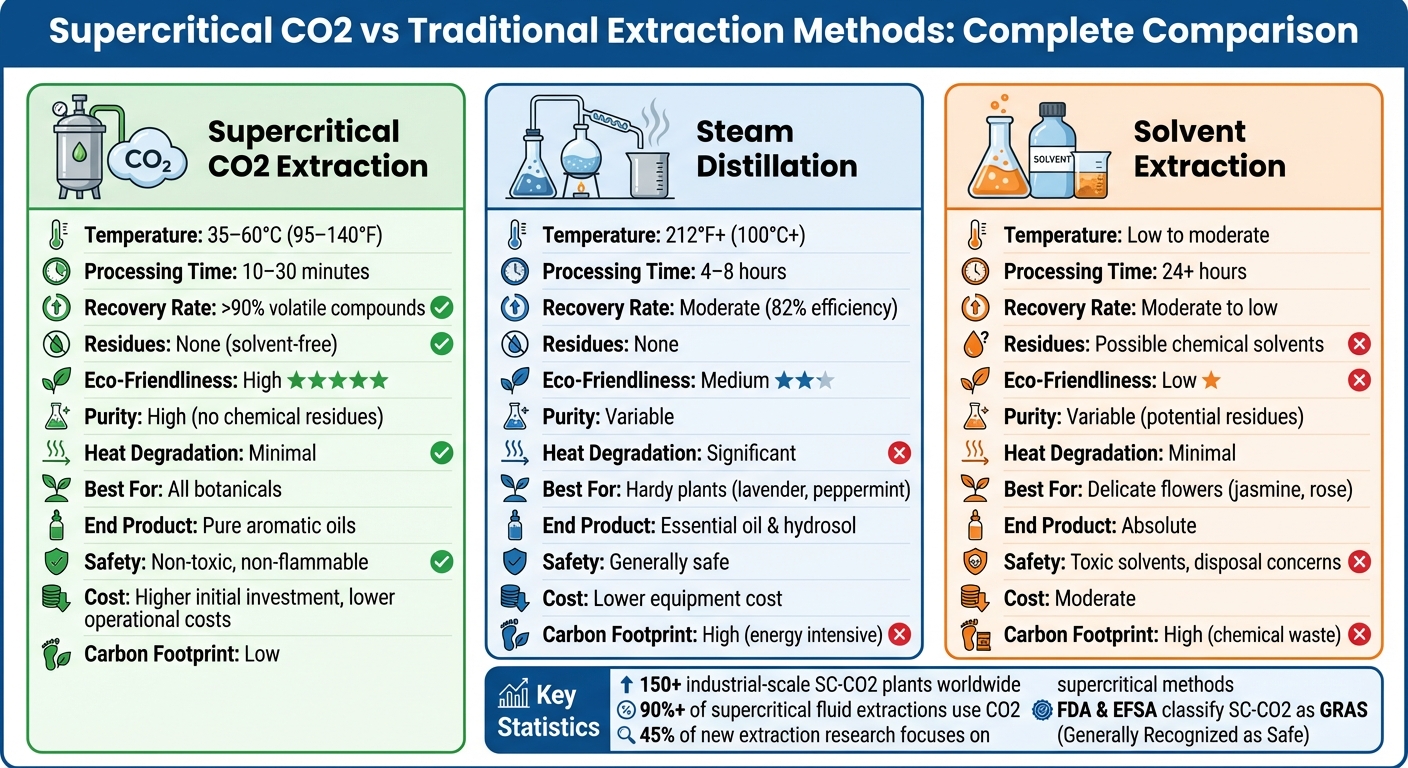
Supercritical CO2 vs Traditional Extraction Methods Comparison Chart
Supercritical CO2 Extraction Explained
How Supercritical CO2 Extraction Works
When carbon dioxide reaches 88°F (31.1°C) and 1,070 psi (73.8 bar), it enters a supercritical state, combining the properties of both a gas and a liquid. In this state, CO2 can penetrate materials like a gas while dissolving compounds like a liquid, making it ideal for extracting aromatic compounds.
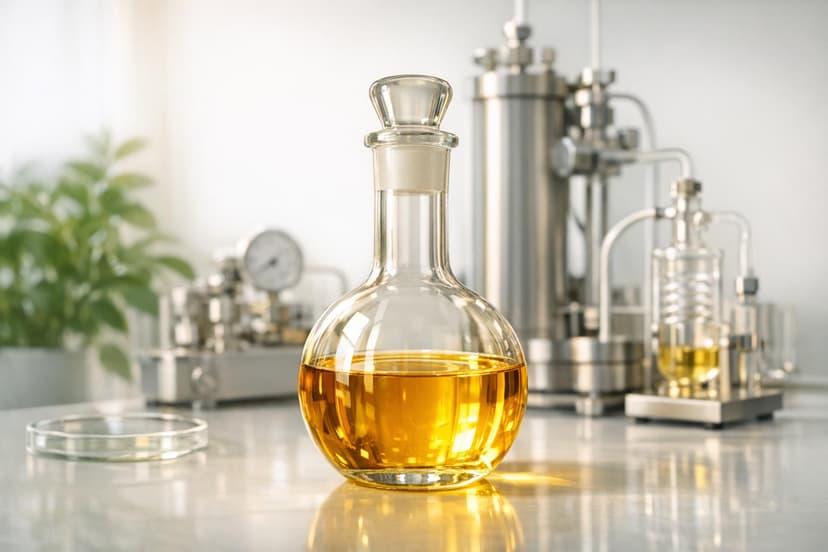
The process begins by grinding botanical materials to about 100 microns - similar to fine coffee grounds - to maximize surface area. Supercritical CO2 is then passed through the material in a high-pressure vessel, dissolving oils and terpenes. When the mixture reaches a separator where the pressure drops, the CO2 quickly reverts to a gas, evaporating and leaving behind pure aromatic oils in a collection vessel. The gaseous CO2 is then captured and recycled for reuse.
Operators can fine-tune the process by adjusting pressure and temperature in stages. This allows the extraction of delicate, heat-sensitive fragrances at lower pressures first, followed by heavier compounds like waxes and lipids in later stages, a technique known as fractionation. This level of precision sets supercritical CO2 extraction apart from traditional methods. Andrea Occhipinti from the University of Turin highlights its unique advantages:
CO2 is the supercritical solvent of choice in the extraction of flavor and fragrance compounds, since it is an odorless, colorless, highly pure, safe, cost effective, nontoxic, nonflammable and recyclable gas allowing supercritical operation at relatively low pressures and near room temperature.
Benefits of Supercritical CO2 Extraction
One major advantage of this method is that CO2 evaporates completely at room pressure, leaving behind a solvent-free extract ready for use.
The process also preserves the integrity of delicate fragrances. Unlike steam distillation, which operates at temperatures above 212°F (100°C), supercritical CO2 extraction works at much lower temperatures - between 95°F and 140°F (35°C to 60°C). This prevents the thermal degradation of fragile aromatic molecules, allowing the true scent profiles of botanicals like jasmine and rose to remain intact. By avoiding the "cooking" effect seen in traditional methods, this technique captures aromas with unmatched precision.
Additionally, CO2’s non-toxic, non-flammable, and inert properties eliminate the need for explosion-proof facilities. With over 150 industrial-scale supercritical fluid extraction plants in operation globally - some with extraction vessels exceeding 17.7 cubic feet (0.5 m³) - the process has proven both scalable and efficient. Recovery rates often exceed 90% for volatile compounds like monoterpenes, making this method particularly suited for high-quality fragrance production.
Uses in Fragrance Production
Supercritical CO2 extraction is celebrated for capturing precise aromatic profiles. Its tunable selectivity enables perfumers to isolate specific fragrance molecules while leaving behind unwanted elements like chlorophyll or waxes. This capability ensures the retention of delicate floral, fresh, and fruity notes that heat-based methods might destroy.
The method has become a favorite in premium fragrance production, where purity and authenticity are paramount. Interestingly, around 45% of scientific studies on new extraction techniques focus on supercritical fluid extraction, particularly in food and pharmaceutical industries. Moreover, CO2 accounts for more than 90% of all supercritical fluid extractions, underscoring its dominance in applications demanding the highest quality standards.
Supercritical CO2 Extraction
Steam Distillation and Solvent Extraction
While supercritical CO2 extraction offers precision and operates at low temperatures, traditional methods like steam distillation and solvent extraction are still widely practiced due to their specific benefits.
How Steam Distillation Works
Steam distillation remains the most common method for extracting essential oils from plants. It works by using hot steam to vaporize the plant’s volatile compounds. These vapors are then cooled, condensing into a liquid where the essential oil naturally separates from the hydrosol due to the immiscibility of oil and water. This process allows volatile compounds to be distilled at temperatures below their boiling points, helping to retain much of the plant’s natural properties.
However, steam distillation can be time-intensive, often requiring over four hours for completion. Researchers Scott A. Sanford and David R. Bohnhoff, from the American Society of Agricultural and Biological Engineers, demonstrated that a continuous-flow steam distillation unit could achieve up to 82% extraction efficiency for mint hay.
How Solvent Extraction Works
Solvent extraction involves soaking plant material in food-grade solvents like hexane, ethanol, or benzene. These solvents dissolve the aromatic compounds, and once the process is complete, the solvent is evaporated, leaving behind a concentrated product called an "absolute".
This method is particularly effective for delicate flowers such as jasmine and rose, which are sensitive to heat. According to USA Lab:
Solvent extraction typically produces a finer fragrance than most other extraction methods which further adds to its appeal for certain applications.
Despite its ability to create refined fragrances, solvent extraction has its drawbacks. Residual solvents can remain in the final product, potentially causing off-notes or physical discomfort. For example, tobacco fragrances extracted this way have been reported to cause excessive tongue astringency.
Limitations of Traditional Methods
Both steam distillation and solvent extraction face notable challenges. In steam distillation, heat degradation is a common issue, as operating temperatures often exceed 212°F (100°C). Exposure to heat, oxygen, or chemicals can alter the aromatic compounds, as chemist Kerri Mixon points out:
None of these extraction methods produces an exact replica of the scent of a fresh plant... due to the fact that these extraction methods denature the aromatic compounds by either exposure to heat, oxygen, or chemical solvents.
Monoterpenes, a group of common fragrance compounds, are particularly susceptible to chemical changes under such conditions. Additionally, some delicate flowers like tuberose lose their fragrance or clump together when steamed, making steam distillation unsuitable for these materials.
Solvent extraction also has its challenges. Beyond the risk of chemical residues, this method requires large quantities of organic solvents, raising concerns about disposal and safety. For instance, traditional Soxhlet extraction may use 50–200 mL of organic solvent for just a 10 g sample, and the process can take over 24 hours to complete. Furthermore, oils produced through solvent extraction are prone to rapid oxidation, potentially reducing their shelf life.
These limitations highlight why supercritical CO2 extraction is gaining traction as a more efficient and precise method for creating high-quality fragrances.
| Feature | Steam Distillation | Solvent Extraction |
|---|---|---|
| Primary Agent | Hot water vapor (steam) | Chemical solvents (hexane, ethanol) |
| End Product | Essential oil & hydrosol | Absolute |
| Temperature | High (212°F+) | Low to moderate |
| Best Used For | Hardy plants (lavender, peppermint) | Delicate flowers (jasmine, rose) |
| Drawback | Heat-induced degradation | Toxic chemical residues |
Your Personal Fragrance Expert Awaits
Join an exclusive community of fragrance connoisseurs. Each month, receive expertly curated selections from over 900+ brands, delivered in elegant 8ml crystal vials. Your personal fragrance journey, meticulously crafted.
Try Your First MonthSupercritical CO2 vs Traditional Methods
Let’s break down how supercritical CO₂ (SC — CO₂) and traditional extraction methods compare in three key areas: quality, efficiency, and environmental impact.
Quality of Extracted Compounds
SC — CO₂ extraction stands out for its ability to preserve delicate, heat-sensitive compounds. Unlike steam distillation, which requires boiling water (around 100°C or 212°F), SC — CO₂ operates at much lower temperatures (35–60°C or 95–140°F). This lower heat helps maintain the integrity of aromatic compounds that might otherwise degrade.
Research from the University of Turin highlights these advantages. Andrea Capuzzo and his team found that tea flower extracts obtained via SC — CO₂ retained their floral and fruity characteristics, which were diminished during distillation. They concluded:
The flavor isolated from SFE was found with superior quality compared to distillation.
SC — CO₂ also extracts compounds that traditional methods often miss. For example, in black pepper extraction, SC — CO₂ achieved higher sesquiterpene-to-monoterpene ratios and captured long-chain n-alkanes (C27–C33) that hydrodistillation failed to recover. This precision aligns with the industry’s move toward capturing true-to-nature profiles. Additionally, SC — CO₂ boasts a recovery rate of over 90% for volatile compounds like monoterpenes in a single step.
| Aspect | Supercritical CO₂ | Traditional Methods |
|---|---|---|
| Purity | High (solvent-free, no residues) | Variable (potential solvent residues) |
| Heat Degradation | Minimal (operates at 35–60°C) | Significant (high heat in steam distillation) |
| Aromatic Profile | True-to-nature | Often altered by heat |
Efficiency and Yield
SC — CO₂ extraction is impressively efficient. What takes 4 hours with hydrodistillation can be accomplished in just 30 minutes with SC — CO₂. For cumin, SC — CO₂ delivered results comparable to an 8-hour steam distillation process - but in a fraction of the time.
This method’s tunability is another advantage. SC — CO₂ can target specific terpenes while excluding unwanted components like waxes. Although the equipment requires a higher initial investment, operational costs are often competitive with, or even lower than, traditional liquid extraction methods. A study in Procedia Engineering noted:
The cost of supercritical extraction processing is comparable to the cost of liquid extraction, and sometimes being even lower.
These savings come from the ability to recycle CO₂, reduced energy needs for solvent recovery, and the elimination of costly safety measures required for butane or propane extraction.
| Aspect | Supercritical CO₂ | Traditional Methods |
|---|---|---|
| Yield Efficiency | High (adjustable selectivity, >85% recovery) | Moderate to low |
| Processing Time | 10–30 minutes | 4–8 hours (steam distillation) |
Environmental Impact
When it comes to sustainability, SC — CO₂ is a clear winner. Carbon dioxide is non-toxic, non-flammable, and leaves no chemical waste. Over 150 industrial-scale facilities worldwide use SC — CO₂, and more than 90% of supercritical fluid extraction applications rely on CO₂.
Traditional methods, on the other hand, often generate chemical waste or require significant energy for processes like steam distillation. SC — CO₂ further reduces its environmental footprint by recycling CO₂ and leaving plant biomass solvent-free, which can then be repurposed as fertilizer or animal feed. These eco-conscious attributes align with the fragrance industry’s push for sustainable practices.
As Shahid-ul — Islam noted in the Journal of Cleaner Production:
Supercritical carbon dioxide extraction is one of the environmental friendly extraction methods.
Both the U.S. FDA and the European Food Safety Authority (EFSA) classify SC — CO₂ as a "Generally Recognized as Safe" (GRAS) solvent, making it ideal for premium fragrance production.
| Aspect | Supercritical CO₂ | Traditional Methods |
|---|---|---|
| Eco — Friendliness | High (recyclable CO₂, non-toxic) | Low (chemical waste, high energy use) |
| Carbon Footprint | Low | High |
Which Method is Better for Fragrance Production?
Main Findings
Supercritical CO₂ extraction stands out as a game-changer in fragrance production, surpassing traditional methods in efficiency, precision, and environmental impact. This advanced technology captures delicate aromatic compounds, delivering over 90% volatile recovery in about 30 minutes. Plus, it leaves no solvent residues behind. In comparison, older techniques like steam distillation and solvent extraction fall short in speed, purity, and accuracy.
Safety is another key advantage. CO₂ is non-toxic, non-flammable, and inert, which means it eliminates explosion risks and hazardous waste concerns. Even the leftover plant material is clean enough to be reused as fertilizer or animal feed. These benefits showcase why SC — CO₂ is becoming the preferred choice in modern fragrance production.
Future of Extraction Methods
The fragrance industry is rapidly embracing SC — CO₂ extraction, driven by growing consumer demand for solvent-free, clean-label products. This shift is not just about meeting customer expectations - it’s also about improving industrial processes.
New multi-vessel supercritical fluid extraction (SFE) systems, particularly those using simulated countercurrent contact, are slashing production costs compared to older two-vessel setups. While the initial investment for SC — CO₂ equipment is higher, the payoff comes quickly. Faster processing times, reduced safety requirements for facilities, and the ability to market products as environmentally conscious all contribute to a quicker return on investment. This progression signals a bright future for sustainable and efficient fragrance production.
Scento‘s Approach to Quality Fragrances

At Scento, we embrace these advanced extraction methods to ensure the highest quality in every fragrance we offer. Whether utilizing state-of-the-art SC — CO₂ technology or traditional techniques, our approach reflects a commitment to sustainable practices and industry innovation. We specialize in offering designer and niche fragrances in accessible formats, such as 8 ml vials or smaller decants (0.75 ml, 2 ml, or 8 ml). This flexible model lets you explore premium scents without the need to invest in full bottles, making fine perfumery more approachable and enjoyable. With Scento, discovering your next signature scent is a tailored, thoughtful experience.
FAQs
What makes supercritical CO2 extraction ideal for preserving fragrance purity?
Supercritical CO2 extraction stands out as a method for preserving the purity of fragrances. By operating at low temperatures, it safeguards delicate aromatic compounds from heat damage. Instead of relying on chemical solvents, this process uses carbon dioxide, ensuring the final product remains clean and free of unwanted residues.
This approach is both efficient and gentle, making it an excellent choice for capturing the authentic essence of fragrances while protecting their quality.
What makes supercritical CO2 extraction more environmentally friendly than traditional methods?
Supercritical CO2 extraction stands out as a process that prioritizes safety and environmental care by eliminating the need for harmful chemical solvents. This approach ensures a safer outcome for both consumers and the planet. By operating at relatively low temperatures, it also conserves energy while protecting the integrity of the extracted compounds, preventing damage from heat exposure.
Another advantage lies in the properties of CO2 itself. It’s non-toxic, can be reused, and is readily available, making it a practical and eco-conscious choice. This method is particularly well-suited for industries that value high-quality production and environmentally responsible practices.
What makes supercritical CO2 extraction more efficient than steam distillation?
Supercritical CO2 extraction stands out for its ability to work at lower temperatures, which helps maintain the integrity of delicate compounds that could break down under heat. By using carbon dioxide in its supercritical state - where it behaves like both a liquid and a gas - it can penetrate materials more thoroughly and target specific compounds with greater precision.
This process is not only quicker but also delivers higher-quality results, thanks to its exceptional capacity to dissolve and isolate desired components. Compared to traditional steam distillation, it’s a go-to method for preserving the potency and quality of natural products.